
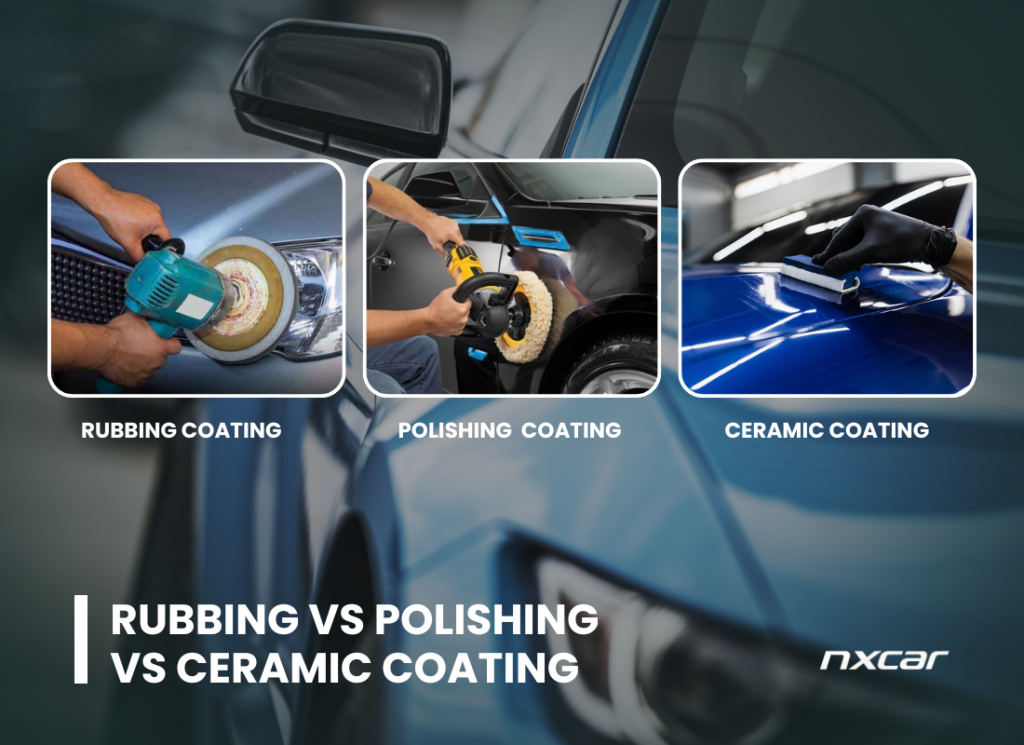
A showroom-fresh shine never lasts forever. One day, your car gleams like liquid glass, and the next, it’s dulled by swirl marks, oxidation, and stubborn grime that clings like a second skin. That’s when the real dilemma begins: Rubbing vs Polishing vs Ceramic Coating — three popular treatments, each promising restoration, brilliance, and long-lasting protection. Yet choosing the wrong one can waste money, damage paintwork, or leave you with disappointing, short-lived results. And that’s where frustration builds. You want a finish that turns heads, not a surface that shows every imperfection under sunlight. You want clarity, durability, and value — not confusion.
As debates grow louder in car-care circles, so does the pressure to make the “right” choice. Should rubbing compounds be trusted? Is polishing enough? Or is ceramic coating the modern marvel it claims to be? Amid the noise, your vehicle deserves a solution that cuts through the haze.
This guide strips away the myths and offers a clear path forward. Whether you’re battling years of neglect or simply craving a pristine, mirror-like finish, the answer to Rubbing vs Polishing vs Ceramic Coating becomes unmistakably simple once you understand what each truly delivers — and which one is best for your car’s needs.
Rubbing vs Polishing
The debate around Rubbing vs Polishing vs Ceramic Coating often begins with the most fundamental question: what truly separates rubbing from polishing? While both are categorized as paint-correction techniques, their intentions — and their outcomes — are remarkably distinct. Understanding these differences ensures the right treatment for the right problem, preventing unnecessary damage and maximizing the brilliance of your vehicle’s surface.
Rubbing: Aggressive Correction for Deep Damage
Rubbing is the heavy-duty repair phase of paint restoration. It uses coarse abrasives to remove a measurable layer of clear coat, revealing a smoother surface beneath. This is the process that rescues severely compromised paintwork.
Where rubbing excels:
-
Removes deep scratches and heavy swirl marks
-
Eliminates oxidized, chalky, or sun-damaged paint
-
Levels out harsh surface irregularities
-
Restores clarity when the finish appears heavily fatigued
Rubbing is transformative — but also unforgiving. Because it physically removes clear coat, improper execution can lead to thinning, patchiness, or even paint burn marks.
Polishing: Fine Refinement for Shine and Smoothness
Polishing, by contrast, is the finesse stage. It uses milder abrasives to refine the surface, enhance gloss, and create a silky, high-definition finish. While rubbing demolishes defects, polishing delicately sculpts the surface.
Polishing delivers:
-
Reduction of fine scratches and micro-marring
-
Enhanced depth, reflectivity, and visual richness
-
Smoother surface texture for better light refraction
-
Preparation for protective layers like waxes or coatings
Polishing doesn’t attempt to repair severe paint degradation. Instead, it perfects what rubbing has already corrected or elevates mildly imperfect paint to near-showroom radiance.
How Their Results Compare
When evaluating the two side by side, the contrast becomes unmistakable:
-
Rubbing = Removal of major defects
-
Polishing = Enhancement of finish quality
-
Rubbing = Functional correction
-
Polishing = Aesthetic refinement
Rubbing restores structural integrity. Polishing reveals beauty. Seeing these processes through the lens of Rubbing vs Polishing vs Ceramic Coating helps clarify their roles. Rubbing addresses the past — the damage already etched into the paint. Polishing shapes the present, refining what remains. Ceramic coating, in turn, safeguards the future, ensuring the newly restored finish stays immaculate for years.
Together, they form a strategic sequence. But individually, their purposes couldn’t be more different.
Ceramic Coating vs Polishing
In the larger discussion of Rubbing vs Polishing vs Ceramic Coating, two processes often find themselves compared more closely than any others: polishing and ceramic coating. Both significantly influence a vehicle’s appearance, yet their intent, technique, and long-term impact diverge dramatically. Understanding how they contrast helps determine whether your car needs refinement, protection, or a strategic blend of both.
Polishing: Surface Enhancement Through Precision Abrasion
Polishing is the artform within the detailing world. It corrects minor imperfections and elevates visual appeal. By employing fine abrasives, it smoothens the clear coat, reducing swirl marks, micro-scratches, and light oxidation.
Key advantages of polishing include:
- Enhanced gloss that reveals paint depth and clarity
- Removal of superficial defects without aggressive abrasion
- Improved smoothness for better reflection and shine
- Essential preparation before applying protection like wax or coatings
Polishing is temporary in effect. As the vehicle interacts with dust, contaminants, and UV exposure, the restored shine gradually diminishes.
Ceramic Coating: Durable Protection with Long-Standing Brilliance
Ceramic coating operates on a different philosophical plane. Instead of correcting the surface, it fortifies it. This liquid polymer chemically bonds with the paint, forming a robust, transparent shield that resists environmental harm.
Ceramic coating provides:
- Long-term protection lasting years rather than weeks
- High hydrophobicity, causing water and grime to glide away
- UV resistance that slows fading and oxidation
- Hardness that guards against light scratches and contaminants
- A continuous glossy, mirror-like finish
Unlike polishing, which modifies the paint directly, ceramic coating preserves the paint by acting as its guardian layer.
The Fundamental Difference
The contrast between polishing and ceramic coating lies in their core purpose:
- Polishing corrects.
- Ceramic coating protects.
Polishing rejuvenates a dull or imperfect finish. Ceramic coating locks in that finish and prevents deterioration.
Which One Should Be Used?
Polishing is essential when paint lacks clarity or shows visible defects. Ceramic coating is ideal when the goal is long-lasting preservation with minimal maintenance.
Viewed within the broader spectrum of Rubbing vs Polishing vs Ceramic Coating, polishing is the step that perfects the surface, while ceramic coating ensures that perfection endures. Together, they form a powerful duo for anyone seeking a high-caliber, showroom-worthy finish that stands the test of time.
When to Use Rubbing for Removing Scratches
Choosing the right method for scratch removal is often a delicate balancing act, especially when navigating the spectrum of Rubbing vs Polishing vs Ceramic Coating. Among these, rubbing — or rubbing compounding — stands out as the most assertive approach. It is designed for situations where surface imperfections run deeper than mere cosmetic wear. Knowing when to deploy this technique can make the difference between a revived finish and unnecessary paint damage.
Understanding the Nature of the Scratch
Not all scratches are created equal. Some merely skim the surface, while others cut deeply into the clear coat.
Rubbing becomes necessary when:
-
Scratches catch your fingernail as you glide it across
-
The paint appears dull, oxidized, or chalky
-
Swirl marks are too severe for gentle polishing
-
Atmospheric damage has created rough, uneven texture
These are signs of deeper abrasion. Rubbing compound, with its coarse formulation, can level these imperfections by removing a thin, controlled layer of the damaged clear coat.
Ideal Scenarios for Rubbing
Rubbing should be considered in the following conditions:
-
Heavy Oxidation
When the paint looks faded or sunburned, rubbing can strip away the degraded layer and restore a richer tone. -
Stubborn Scratches and Water Spots
Hard water etching and stubborn marks often sit too deep for polish. Rubbing offers the muscle needed to break through. -
Pre-Restoration Preparation
Vehicles undergoing major paint correction may require rubbing as the foundational step before finer refinement. -
Correcting Neglected Surfaces
Cars left exposed to environmental contaminants for years often develop harsh blemishes that only rubbing can address effectively.
Caution: Controlled Power
Because rubbing is abrasive, it must be used with deliberation. Overuse can thin the clear coat, leaving the surface vulnerable. It is best reserved for targeted correction rather than full-body application, unless performed by an expert.
How Rubbing Fits into the Larger Picture
Within the broader understanding of Rubbing vs Polishing vs Ceramic Coating, rubbing plays the role of the heavy lifter. It resolves serious paint issues that neither polishing nor ceramic coating can remedy alone. Polishing refines the surface after rubbing; ceramic coating protects the newly corrected finish.
Rubbing is not an everyday detailing activity. It is a strategic intervention — powerful, transformative, and indispensable when dealing with stubborn, deeper scratches that demand decisive action.
Best Practices to Protect Your Car’s Paint Finish
Protecting your car’s paint finish demands a blend of vigilance, routine care, and smart product choices. With factors like UV radiation, airborne contaminants, and abrasive dust constantly attacking the surface, understanding how to shield your vehicle becomes crucial. When viewed through the lens of Rubbing vs Polishing vs Ceramic Coating, paint protection evolves from a reactive effort into a well-structured preservation strategy.
Wash Smart, Not Just Often
Frequent washing helps, but technique matters more than frequency.
Key habits include:
-
Use pH-balanced car shampoos instead of household detergents
-
Adopt the two-bucket method to avoid reintroducing dirt
-
Dry with microfiber towels to prevent swirl marks
A meticulous wash routine lays the foundation for smooth, contaminant-free paint.
Embrace Clay Bar Treatment for a Smooth Canvas
Even after washing, microscopic impurities cling stubbornly to the surface.
A clay bar helps extract embedded contaminants, improving texture and preparing the paint for further protection.
When to clay:
-
Twice a year for daily-driven cars
-
Before polishing or applying protective coatings
Polish with Purpose, Not Impulse
Polishing shouldn’t be part of every wash cycle. It’s a corrective measure that restores gloss when dullness or micro-scratches appear.
Smart polishing practices:
-
Use mild polishes unless dealing with noticeable imperfections
-
Follow polishing with a protective layer for longevity
-
Avoid over-polishing to preserve clear coat thickness
Polishing refines the surface, but overuse can be counterproductive.
Ceramic Coating: A High-End Shield
Ceramic coating offers durable defense against fading, chemical stains, and minor abrasions. Its hydrophobic properties keep the car cleaner for longer, while its glossy sheen enhances visual appeal.
Why ceramic coating stands out:
-
Protects against UV rays and oxidation
-
Reduces the need for frequent waxing
-
Maintains shine with minimal effort
It doesn’t replace polishing — it preserves its results.
Avoid Aggressive Rubbing Unless Necessary
Rubbing compound is a powerful tool, but its abrasiveness requires prudent use.
Use rubbing only when:
-
Deep scratches or severe oxidation demand intervention
-
Polishing alone cannot restore clarity
Rubbing is the rescue operation, not routine maintenance — a crucial point when understanding Rubbing vs Polishing vs Ceramic Coating.
Store and Park Strategically
Whenever possible, park in shaded or covered areas. UV exposure accelerates fading, while bird droppings and tree sap can etch into the paint.
Protecting your car’s paint is a long-term commitment. With the right practices and a thoughtful blend of maintenance and protection, your vehicle can retain its gloss, richness, and showroom charm for years.
Pros and Cons of Rubbing vs Polishing vs Ceramic Coating
Understanding the strengths and limitations of each paint-care technique helps you make a well-informed choice. When comparing the three under Rubbing vs Polishing vs Ceramic Coating, each method offers unique advantages — and important caveats.
Rubbing (Rubbing Compound)
Pros
-
Effectively removes deep scratches and heavy oxidation
-
Revives severely dull or damaged paint
-
Delivers dramatic, visible improvement in a single session
-
Essential for restoring neglected paintwork
Cons
-
Highly abrasive and can thin the clear coat
-
Requires expert technique to avoid holograms or burn marks
-
Not suitable for frequent use
-
Needs follow-up polishing for a smooth, glossy finish
Polishing
Pros
-
Enhances shine and optical clarity
-
Smoothens swirl marks, micro-scratches, and mild imperfections
-
Improves light reflection for a richer, deeper gloss
-
Ideal preparation before protective coatings or waxing
Cons
-
Temporary results that fade with exposure and time
-
Cannot repair deep scratches or significant damage
-
Over-polishing can weaken the clear coat
-
Requires proper tools and controlled application
Ceramic Coating
Pros
-
Long-lasting protection that can endure for years
-
Hydrophobic surface repels water, dirt, and contaminants
-
Shields paint from UV rays, oxidation, and mild abrasions
-
Maintains gloss with minimal maintenance
Cons
-
Does not correct scratches or imperfections
-
Requires properly polished paint before application
-
Professional-grade coatings can be expensive
-
Improper application can cause streaking or high spots
Each method plays a different role in the broader scope of Rubbing vs Polishing vs Ceramic Coating. Rubbing restores the damaged surface. Polishing refines it. Ceramic coating preserves it.
Choosing wisely — or combining them strategically — ensures your car’s paint remains vibrant, protected, and visually striking.
FAQs on Rubbing, Polishing, and Ceramic Coating
1. Can rubbing compound remove all types of scratches?
Not always. Rubbing compound can eliminate deep scratches that penetrate the clear coat, but if a scratch reaches the base paint or primer, rubbing will not fix it. In such cases, repainting may be required.
2. How often should I polish my car?
Polishing should be done sparingly—typically once or twice a year. Over-polishing can thin the clear coat, so it’s best reserved for when the surface truly needs refinement.
3. Does ceramic coating replace waxing or polishing?
Ceramic coating replaces waxing but not polishing. The surface must be polished first for best results, as ceramic coating locks in the paint’s current condition—imperfections included.
4. Is ceramic coating worth the price?
Yes, for those seeking long-term protection and reduced maintenance. Ceramic coatings last years, offer strong hydrophobic performance, and protect against UV damage, making them a worthwhile investment.
5. Should rubbing, polishing, and ceramic coating be done together?
They can be—when necessary. The ideal sequence is:
Rubbing (for heavy defects) → Polishing (for gloss and refinement) → Ceramic Coating (for long-term protection).
This combination yields the best, longest-lasting finish.